

Turks & Caicos
In August 2014 my family flew down to Providenciales to celebrate two fiftieths at once — my dad’s birthday and my grandparents’ anniversary. I came home with a camera full of water, four blog posts, and a theory about lunch. This is that week, and everything I have learned since about the islands underneath it.
The colour starts before you land.
Down through the water, then back to shore.
Providenciales sits on the rim of a bank the size of a small county, and a week there turns out to be entirely about water — how far down you can see through it, and what it did to these islands long before anyone came to swim in it. So the first half of this page goes down. The second comes back up onto the sand.
Even the window seat is a preview.
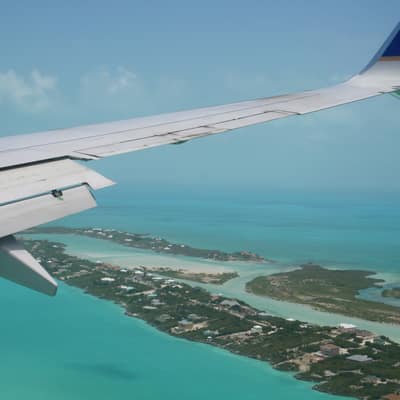
Providenciales is three hours and forty minutes from JFK or Newark, which is barely long enough to finish a film. You spend the last twenty minutes of it looking down at a colour you assume has been corrected. It has not. The Caicos Banks are nearly 1,700 square miles of water averaging under twenty feet deep, so the light goes all the way to the bottom and comes back up again.
That is the whole arrival, really. Air conditioning, a door, and then the Caribbean, which sits between 75 and 95°F all year round and does not much care which month you picked.
Read day one3 h 40 m
Nonstop from JFK or Newark. JetBlue and United fly it year round; Delta, American and BermudAir add seasonal winter service.
Kayak route dataNo form to fill in online
There is no ETA, no eVisa and no digital arrival card. The pandemic-era TCI Assured portal stopped being required in May 2022, and people still sell fake “authorisations” for it.
VisitTCI entry requirementsSame clock, mostly
The islands sit on UTC−5 all year and never move for daylight saving, so from March to November they are an hour behind New York.
VisitTCI time and dateTwo fiftieths, one island.
It was a small boutique place rather than one of the big Grace Bay resorts, and at nineteen I was clearly keeping a list of the details that made it feel looked-after.
Reading it back a decade on, what strikes me is how little of the week was planned. Nobody had an itinerary. We had a beach, a family with two anniversaries to mark, and a lot of afternoons.
You can see all the way down.
The Caicos Banks cover nearly 1,700 square miles and average under twenty feet deep, which is why a parasail ride here comes with a floor. It is also why the paddleboarding was so easy to romanticise: the water was flat enough to stand on, and pale enough that your own shadow followed you along the bottom.
Read the paddleboarding postThe reef nobody can agree about.
Half the tour brochures here will tell you this is the third largest barrier reef in the world. The islands’ own tourism authority and their reef charity both say something more defensible, and more interesting.
It is the second largest barrier reef system in the Western Hemisphere, after the Mesoamerican reef off Belize and the Yucatán — about 340 miles of it in total, roughly 240 miles wrapped around the Caicos Islands and another 100 around the Turks. Around 60 species of coral and more than 250 species of fish live on it. Either way, it is enormous, and mostly empty of people.
The Wall
The reef does not slope away, it stops. At Northwest Point, West Caicos, French Cay, Grand Turk and Salt Cay the shallow reef gives out and the sea floor drops thousands of feet, often almost vertically.
VisitTCI barrier reefA disease, and a treatment
Stony coral tissue loss disease reached these islands in 2019. It attacks more than twenty reef-building species, and an infected colony can die within days. Divers now treat it with an antibiotic ointment: at the first test site here, 92% of treated colonies survived at two weeks and 100% at two months, while the untreated ones died completely.
Marine Conservation SocietyWhat you may not take
Inside a national park it is illegal to fish, to collect conch or lobster, or to remove shells, coral, sand or artefacts — Grace Bay included. You may fly home with up to three mature conch shells of seven inches or more. Coral, never: customs will take it.
VisitTCI on shells and coralSeven thousand feet, right there.
The country is cut in half by a trench. The Columbus Passage — the Turks Island Passage on older charts — is about twenty miles wide and over 7,000 feet deep, and it separates the Caicos Bank from the Turks Bank.
From late December to early April it works as a corridor. Humpbacks come down from Iceland, Greenland, Canada and the Arctic to calve and mate on the shallow banks near here and off the Dominican Republic, and the trench funnels them straight past Salt Cay and Grand Turk. Sightings peak in February. The males sing for ten to twenty minutes at a stretch, in a song you can hear for miles underwater.
And JoJo
Somewhere off this coast is a wild bottlenose dolphin called JoJo, who has spent forty years seeking out swimmers and boats along the north shore of Providenciales rather than staying with a pod. The government made him a national treasure in 1989. He is scarred all over from boat strikes, and an American called Dean Bernal, who met him in the early-to-mid 1980s, became his official warden and spent decades keeping him out of a marine park.
Being honest about what is knowable: the tourist board still writes about him in the present tense and reviewed that page in July 2026, and a younger dolphin called Dreamer has picked up his habit of approaching people. But I could not find a dated, verified public sighting of JoJo after 2022, and a bottlenose thought to be in his fifties is old. Nobody has announced anything. That is genuinely where it stands.
VisitTCI on JoJoThere is no swim-with-dolphins here
The islands have no captive dolphin attraction and no dolphin tour operators at all. Every encounter is wild and by chance, feeding a marine mammal is illegal under Turks and Caicos law, and the campaign that grew up around JoJo — “JoJo says NO” — is explicitly against captivity. If you have booked a dolphin swim somewhere in the Caribbean, it was not here.
Whale trips do run, from Salt Cay, Grand Turk, South Caicos and Providenciales, between roughly late December and early April.
VisitTCI whale watchingSomebody in London thought these were igloos.
A country named after a cactus in a fez.
The official account is that “Turks” comes from the Turk’s head cactus, Melocactus intortus, a squat ribbed barrel that grows a red flowering crown on top which looked, to whoever was naming things, exactly like a fez. “Caicos” is Lucayan: caya hico, a string of islands. It is worth knowing that VisitTCI disputes the cactus half, arguing that “Turks” was once a synonym for pirate and that mapmakers were marking dangerous water. Neither is settled.
The flag is a better story. From 1869 the badge showed a salt raker, a ship and two heaps of salt waiting on the shore for it. The flag-maker in London had never seen a salt pile, decided they were igloos, and helpfully added a door to one of them. Nobody corrected it for ninety-nine years, until the new coat of arms arrived in the 1960s.
The national plant
The cactus. The national bird is the brown pelican, the national tree the Caicos pine, the national flower the island heather, and the national music is ripsaw.
Radio Turks and CaicosWhat replaced it
The 1968 flag carries the gold shield: a queen conch, a spiny lobster and a Turk’s head cactus. Two flamingos hold up the coat of arms.
VisitTCI on the flagDeep blues and purples to bright reds and oranges.
The best thing nineteen-year-old me wrote down that week was about the sky, and it is still exactly right.
There is a second sentence in that post I had completely forgotten, and it explains most of the photographs on this page: “So glad I brought my new prime lens on this trip because I’ve been trying to capture some cool sunset shots with my Sony NEX.” Somewhere in there is the beginning of this entire blog.
Conch, and the two-hour lunch.
The national dish is peas and hominy with dried conch. Everything else on a menu here is the same animal in a different jacket: conch salad chopped raw in front of you with citrus and peppers, cracked conch beaten flat and fried into strips, fritters, chowder, curried, scorched, stewed.
The beating is done with a conch bruiser, a mallet of lignum vitae wood, and dried meat used to be laid out two by two in the sun until it turned into something close to jerky. Live conch are still kept in a penned enclosure called a conch crawl. The shells were burned for lime, used as scoops in the salt ponds, and blown as horns — two short and one long.
The world’s only conch farm is closed
The Caicos Conch Farm opened in 1984 and raised queen conch commercially, with two pet conchs called Sally and Jerry for the visitors. Hurricanes Irma and Maria finished it in 2017. In May 2026 the government bought the site for $12 million to build a public marina for local watersports operators. Guidebooks still send people there.
Magnetic Media, May 2026It is not an unlimited resource
Conch is worth $3.5–5 million a year in exports, almost all of it to the United States. The export season was closed from 15 July to 15 October 2025 over stock concerns, and Monterey Bay Aquarium’s Seafood Watch currently rates Turks and Caicos conch “Avoid”. Eat it there; think twice about buying it at home.
Magnetic Media, July 2025And the rest of the menu
Johnny cake, a slightly sweet pan-baked cornbread, takes its name from “journey cake” because it kept on long fishing trips. Peas and grits, boiled fish, whelk soup. Bambarra rum is blended on Providenciales and named after a Middle Caicos settlement. The country’s only brewery names its beers I-Soon-Reach, I-Ain-Ga-Lie, Down-Da-Road, Gon-Ta-Nort and Gone-Ta-Sout.
VisitTCI cuisineNow, the service
I want to keep this bit exactly as I wrote it, because it is the only complaint in four posts and it is still funny.
“I’ve finished countless meals before I could ask for drink refills so now I order 3 drinks when I sit down.”
“One day, we went out for breakfast and by the time we paid, we had to order lunch.”My Trip to Turks and Caicos (So Far)
Then there is the order that has followed me around for eleven years. My dad asked for “I’ll get chicken fingers and two orders of conch critters please.”
Island time has an official definition
Here is the part nineteen-year-old me did not have. The tourism board puts it in writing: within the local community it is normal to arrive on island time, “that is to say, 5–40 minutes late”. Tourism businesses keep stricter schedules. Most travel writing waves at this. Turks and Caicos gives you a range.
A family from New Jersey, where the pace is the pace, spent a week bumping into a thing the country had already told us about.
VisitTCI etiquette and tippingAnd for the record, the same post ends like this: “But aside from the food-service situation, we’ve been laying out by the beach and enjoying our time in Turks and Caicos! Loving the friendly staff here at our resort and the soft sand where there’s not a rock to be seen.”
The national instrument is a carpenter’s saw.
Ripsaw is the national music of the Turks and Caicos Islands, and playing it is called ripping the saw. It is not a gimmick and it is not a novelty act — it is the sound of these islands, and most visitors go home without hearing a note of it.
How it is actually played
You hold the handle up with the teeth facing away from you and brace the narrow end against your thigh. Then you scrape the teeth with an old knife blade — a nail, a fork or a screwdriver will do — and bend the blade as you go, which bends the note into a wobble in time with the beat. Lovey Forbes, who documented the music more thoroughly than anyone, recommended an eleven-point saw: finer teeth, cleaner sound. Dez Misick’s advice was to use only your wrist, or you will not last the three-hour set.
Around the saw sits a goatskin drum, a concertina or accordion, maracas made from gourds, and a box guitar. Middle Caicos and North Caicos are the heartland.
Times of the IslandsJunkanoo, and the masses
The older local form was called the masses, or massin’: groups of men moving between houses through Christmas night, playing and dancing. Modern Junkanoo here is smaller than the Bahamian version — thirty to fifty performers rather than thousands — and there is no singing at all, only call and response across drums, cowbells, horns and a handmade instrument called a kalunka: a hanging metal bar with two cowbells and two jam blocks.
The costumes start as cardboard, shaped with wire and contact cement, then covered in crepe paper or felt. They take weeks, and new ones are built every year.
VisitTCI on JunkanooThe Bight, Providenciales. Fifteen or more local food and drink vendors, bands from 6pm, and a Junkanoo parade at about 8:30.
Da Conch Shack on Blue Hills Road, 8pm, with the We Funk Junkanoo band — the oldest and largest Junkanoo group in the country.
Grace Bay Road closes from around 6pm. Steel bands first, Junkanoo groups from about 9, then fireworks. Over a thousand people; parking is hopeless.
Bambarra Beach, Middle Caicos. The biggest day of the island’s year, and the boats are two feet long. More on that below.
Dates change. VisitTCI major events is the page to check before you book.
Plaited an inch at a time.
Straw work has been made on North and Middle Caicos for centuries, out of fanner grass and the fronds of the silver top and buffalo top palms. Fronds are plaited into strips between one and three inches wide and then stitched together with a needle and dried grass instead of thread. Fanner grass is coiled instead, wound round and stitched tight.
A coaster takes a few hours. A complicated fanner basket takes weeks. They also make hats, fans, bags, place mats, Christmas ornaments, and model Caicos sloops in straw.
The Middle Caicos Co-op was set up in 1998 to keep the craft alive and pay the weavers properly, and about eighteen artisans work through it. One thing every out-of-date blog post gets wrong: despite the name, the shop is no longer in Conch Bar. It is at My Dee’s Plaza on King’s Road, Major Hill, North Caicos, about fifteen minutes from the Bellefield Landing ferry dock.
VisitTCI straw workWeeks, for one basket
Isilda Reid, Alveria Duncombe, Sharon Taylor and Irene Higgs are among the named artisans. The co-op also sells at the Valentine’s Day Cup each February.
The two-foot regatta
The Valentine’s Day Cup on Bambarra Beach is raced with handmade model Caicos sloops: hulls carved from gumbo limbo wood, two to three feet long and three to four feet tall to the masthead, steered by tugging a thin tethered cord from the beach. Ladies’ Open, Men’s Open, B-Class and the Premier’s Cup. Free to watch, and the only day of the year Bambarra could be called crowded.
VisitTCI Valentine’s Day CupFor three centuries the export was salt.
Bermudians arrived in the 1670s looking for it. Bermuda was too cool and too damp to make white gold of its own, but it had sailors and cedar for ships, and these islands were flat, hot, windy and empty.
They turned the natural ponds into salinas: seawater let in through a channel or a tidal cave, sluice gates, and windmill or hand pumps moving brine through a sequence of smaller, saltier ponds divided by low stone walls until the salt crystallised out. Grand Turk, Salt Cay and South Caicos did this for three hundred years. Slavery entered the salt trade in the 1770s, and the rules under Bahamian administration were brutal.
What the salt left behind
Salt Cay keeps it best: the stone walls around every former pond are intact, you can see where the sea was let in, and the White House still stands, salt equipment stored below and the proprietor living above. On Grand Turk most of it has gone under development, though the walls and some sluice ruins survive and flamingos feed in the ponds.
And the donkeys. The animals that hauled the salt carts never left. Around 300 of them now roam Grand Turk’s ten and a half square miles, along with horses and cattle. It photographs beautifully and it is, locally, a real problem: animals in traffic, property damage, grazing land disappearing under development, and an SPCA without the funding to manage it.
VisitTCI salt industryWho was here first.
The Lucayans, a branch of the Taíno, reached these islands from the south more than a thousand years ago. Somewhere between ten and fifteen thousand of them were living here before Columbus. Within a single generation of his landing they were gone — shipped to Hispaniola to mine gold, and killed by violence and disease.
What they left
Palmetto Ware pottery, bone tools, and nine or so duhos — carved wooden ceremonial seats — several of which were stolen or sit in overseas collections. A canoe paddle found at North Creek on Grand Turk in 1996 dates to somewhere between 995 and 1235.
Turks & Caicos National MuseumThe oldest wreck in the hemisphere
A Spanish caravel from around 1513 lies on Molasses Reef, twenty miles south of Providenciales — the oldest European shipwreck ever excavated in the Western Hemisphere. Treasure hunters found it in the 1970s, dynamited it looking for gold, and announced it was Columbus’s Pinta. It was not. Texas A&M excavated it properly between 1981 and 1986.
The museum on Molasses ReefThe Trouvadore
In 1841 a slave ship carrying 178 captives from Africa to Cuba wrecked off East Caicos. The survivors were freed under British law, made to work on Grand Turk, and went on to found settlements including Bambarra on Middle Caicos in 1842. Many people on Middle and North Caicos descend from them, and the settlement name probably comes from the Bambara people of Mali.
The museum on slaveryEmancipation reached these islands on 1 August 1834 in law and 1 August 1838 in fact, after the apprenticeship scheme was cut short. Britain compensated the owners. It compensated nobody who had been enslaved. All of this is kept in Guinep House on Front Street in Cockburn Town, a roughly two-hundred-year-old building that holds the national museum — five dollars in, free for children. Its Providenciales branch, the Caicos Heritage House at The Village at Grace Bay, is closed until 20 October 2026. National Museum, visiting
Something here exists nowhere else.
The Turks and Caicos rock iguana is found on these islands and nowhere on earth besides. It is the largest native land animal in the country, and in 2020 the IUCN moved it from Critically Endangered to Endangered — a rare piece of conservation news going the right way.
About 30,000 adults across roughly 75 cays, after feral cats and dogs were cleared from ten connected cays in 2019 — but still gone from over 90% of its historic range. Walk the boardwalks at Little Water Cay for $20, stay on them, and do not feed anything.
American flamingos hold up the national coat of arms and feed in salt ponds all over the country. Flamingo Pond Overlook on North Caicos is the named viewing spot — bring binoculars, they stand a long way off. The birds in the Grand Turk salinas are far easier to get near.
Best seen from the cliffs at West Harbour Bluff on Providenciales, where pelicans, ospreys and white-tailed tropicbirds glide past at eye level. There is usually an osprey nest on the Northwest Point lighthouse.
The pine yards of North Caicos, Middle Caicos and Pine Cay lost around 95% of their mature trees between 2000 and 2010 to an invasive scale insect from North America. A recovery project with Kew runs a nursery and a seed bank. The national flower, island heather, grows nowhere else on earth either.
What has changed since we were there.
Eleven years is long enough for a country to rearrange itself. Everything in the right-hand column was checked in September 2026.
| 2014 | 2026 | Worth knowing | |
|---|---|---|---|
| The Caicos Conch Farm | Open. The only commercial conch farm in the world, with two pet conchs called Sally and Jerry. | Permanently closed since Hurricanes Irma and Maria in 2017 — and in May 2026 the government bought the site for $12 million to turn it into a public marina for local watersports operators. | Still listed as an open attraction on plenty of tour sites nine years later. |
| Grace Bay’s ranking | Routinely called the best beach in the world. | #17 in the World’s 50 Best Beaches 2026, and a Tripadvisor Travellers’ Choice winner — but not in Tripadvisor’s 2026 world top ten. | The “#1 beach in the world” line you still see quoted has no year attached to it. |
| Getting there from New York | A short hop with a handful of carriers. | About 3 h 40 m nonstop from JFK or Newark, averaging $527 round trip. United adds Denver in December 2026; BermudAir adds five more US cities for the winter. | |
| How busy it is | Quiet enough that a boutique resort felt like a private beach. | 384,590 stayover visitors in the first half of 2026 alone, up 6% year on year — the strongest first half on record. | Nearly two million visitors came through in 2025. |
| The clock | Same time as home on the east coast. | Still UTC−5 all year, and the islands do not move for daylight saving — so from March to November they are an hour BEHIND New York. | The single most useful fact here if you take calls. |
| What is in your bag | Nobody thought about it. | A single stray bullet is an arrest. The mandatory minimum of 12 years is still on the books; a June 2024 amendment lets judges fine instead, and the 2024 cases ended in fines of $2,000–$9,000 after weeks stuck on the island. | Turn every bag inside out before you fly. |
Everything I wish I had known.
Sourced and dated, because half of what is written about these islands online is four years stale. If you are reading this a long way from September 2026, check the links before you book anything.
- Nonstop from the NY area
- JetBlue from JFK year round, United from Newark year round, Delta and American from JFK seasonally from November, BermudAir from Newark from December. About 3 h 40 m.
- What it costs
- NY–Providenciales round trips run roughly $409–$729, averaging $527 over the past twelve months. Cheapest around December and January; dearest in August.
- The catch
- Airfare and hotel rates peak at different times. December to April is the expensive season on the ground, and the cheap season in the air.
- At the airport
- Phase one of the Providenciales airport expansion — a 40,000 sq ft terminal extension — is due to begin construction in 2026. It is already congested at peak times. Leave extra room on the way home.
- How long you get
- Up to 90 days visa free for US, Canadian, UK and EU passports — but officers often stamp 30 by default. Ask at the desk for the full 90.
- There is no online form
- TCI Assured, the pandemic-era portal, stopped being required on 1 May 2022. There is no ETA, no eVisa and no digital arrival card. You fill in a paper card on the plane. Do not pay a third party for a “travel authorisation”.
- Passport validity
- The official sources genuinely disagree — three months, six months, or the length of your stay, depending which you read. Travel with six months and you satisfy all of them.
- Departure tax
- Around $60–85 of government charges per departing passenger, already inside your ticket price. Nothing to pay in cash at the airport.
- There is no nomad visa
- The official tourist-information site says it plainly: there is no scheme dedicated to digital nomads. If you see “Turks and Caicos work-from-paradise visa” somewhere, it is a confusion with Barbados, Bermuda, Anguilla, Montserrat or Cayman.
- So what do people do
- Remote work is technically not permitted on a visitor stamp, and in practice it is not policed. Working for a local business is a different matter and is strictly forbidden. Go in with your eyes open.
- The connection
- Fixed broadband averaged 85 Mbps down and 77 Mbps up across the islands for the year to June 2026, and rentals typically offer 50 Mbps or better. One catch worth knowing: the whole country hangs off a single submarine cable, and neither carrier runs 5G.
- Somewhere to sit
- On Island, on the ground floor of the One Season plaza on Grace Bay Road, is the only dedicated coworking space on Providenciales. $40 a day, $180 a week, $479 a month unlimited, open 8am to 8pm. Meeting room $25 an hour for members.
- The clock again
- UTC−5 all year with no daylight saving. From March to November you are an hour behind New York, so a 9am standup is an 8am standup.
- There is no public transport
- None. No buses, no trains, no Uber, no Lyft. This is the budget surprise that gets first-timers, because taxis charge per person rather than per car.
- Taxis
- Fares are capped by government but not metered, and pre-booked rides are exempt from the caps entirely. Providenciales airport to Grace Bay runs about $28 for two people shared, or from $135 for a private transfer. Agree the fare before you get in.
- Driving
- On the left, in a left-hand-drive American car, from about $50 a day. Minimum age 25 at almost every company. Do not drive on the beach — the sand will bog down a four-wheel drive.
- The other islands
- The North Caicos ferry runs from Heaving Down Rock, takes 25–30 minutes and costs $40 one way or $70 return. No car ferry, so rent on arrival — and a causeway carries you straight on to Middle Caicos. Grand Turk is a 30-minute flight, around $150 return.
- Currency
- The US dollar, and only the US dollar. No exchange, no conversion fee, no mental arithmetic.
- Why it is expensive
- Almost everything is imported, mostly through Florida, and lands with a 35% tariff on most goods. Groceries sit at or above New York prices.
- The stack on your bill
- 12% tourism tax plus a 10% service charge is required at resorts and resort restaurants, and some properties add a 5% facility fee on top. Reckon on 32–42% above the advertised rate before you tip.
- Rough numbers
- Grace Bay hotels from about $240 a night at the budget end and $372–$559 mid-range. Conch salad $12–18. A pint of local draught about $5. Dinner for two, mid-range, around $120.
- High season
- December to April, when rooms run 30–50% above the rest of the year.
- Low season
- Late August through early November — which is also hurricane season. Mid-August to September is the likeliest window for a storm, and September historically carries about a one in seven chance.
- The record since his trip
- No damaging storm has hit since Irma and Maria in September 2017. Oscar in 2024 and Erin and Melissa in 2025 all passed with minor or no damage.
- Sargassum
- Worst in late summer and early autumn, and it lands on the windward south and east coasts — Long Bay, Cooper Jack, Five Cays. Grace Bay and the northern lee-side beaches stay largely clear.
- Whales
- Humpbacks come through from late December to early April, peaking in February, funnelled along the Columbus Passage past Salt Cay and Grand Turk.
- The sweet spot
- Late April to May, or early November: shoulder pricing, 80°F water, low storm odds, sargassum not yet at its worst.
- Ammunition. Seriously.
- It is illegal to bring firearms or ammunition into the country, including a single stray round forgotten in a bag. The minimum sentence on the books is twelve years. A June 2024 amendment gave judges room to fine instead, and the Americans arrested that year paid $2,000–$9,000 and lost weeks of their lives to it. Empty every pocket of every bag.
- Drugs
- Small amounts bring fines up to $5,000 and two years. Importing cannabis carries five years and up to $75,000, and a medical card from home counts for nothing.
- Medical cover
- Two hospitals, and anything serious means an air ambulance off the island. US Medicare does not travel. Evacuation cover is the one non-negotiable purchase.
- Crime
- The US advisory sits at Level 2, the same level as France, reaffirmed in July 2026 and citing crime on Providenciales. TCI reports violent crime down 42% year on year. The UK notes crime on the other islands is low.
- The reef
- Inside a national park it is illegal to fish, to take conch or lobster, or to remove shells, coral, sand or anything else. You may export up to three mature conch shells; coral, never. Do not stand on the coral, and do not feed anything.
Four posts, one week.
Written in 2014 and 2016, kept as they were.
My Trip to Turks and Caicos
Day one, written the day it happened: the wall of heat outside the airport, and a first afternoon on the clearest water I had ever stood in.
August 8, 2014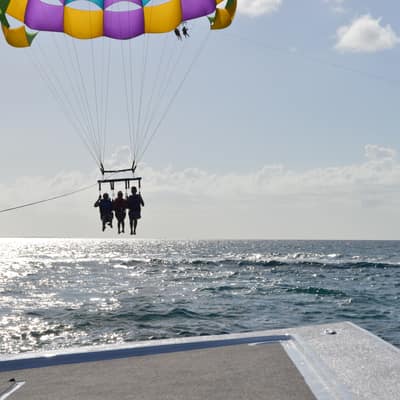
My Trip to Turks and Caicos (So Far)
The long one. Why we came, the fruit punch and the cold lemon towels, parasailing over water you can see the bottom of, the sunsets — and the two-hour lunches.
August 12, 2014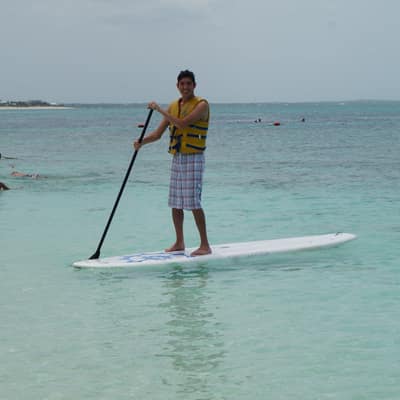
Paddleboarding in Turks and Caicos
A photo challenge entry, posted once I was home: standing up on a board on water so still it looks like a floor.
September 5, 2014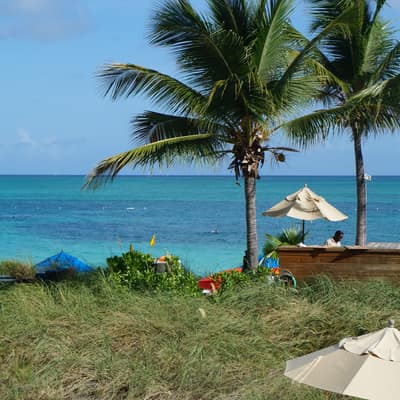
The Enchanting White Sand Beaches of Turks and Caicos
Eighteen months later, packing for Aruba and thinking about this place instead. The short, honest version of what stayed with me.
February 9, 2016Eighteen months later, I was still thinking about it.
In February 2016, packing for Aruba, I wrote one line about this trip and then went quiet: “Remembering the time I spent in Turks and Caicos while becoming more and more excited about my upcoming trip to Aruba. Can’t wait to be back in the Caribbean.”
I have been back to the Caribbean since. I have not been back here. It is three hours and forty minutes away.